نوین فایل مجله اینترنتی نوین فایل | کالای دیجیتال

شاید این مطالب برایتان مفید باشد



How SMM Reseller Platforms Help Agencies Scale Social Media Services
The demand for social media marketing continues to grow as businesses increasingly rely on digital channels to reach customers, build brand awareness, and maintain relationships with their audiences. This shift has created new opportunities for digital marketing agencies, freelancers, and social media managers.
However, growing an agency is not simply a matter of acquiring more clients. As the number of accounts increases, so does the workload involved in content distribution, audience growth, campaign management, reporting, and client communication.
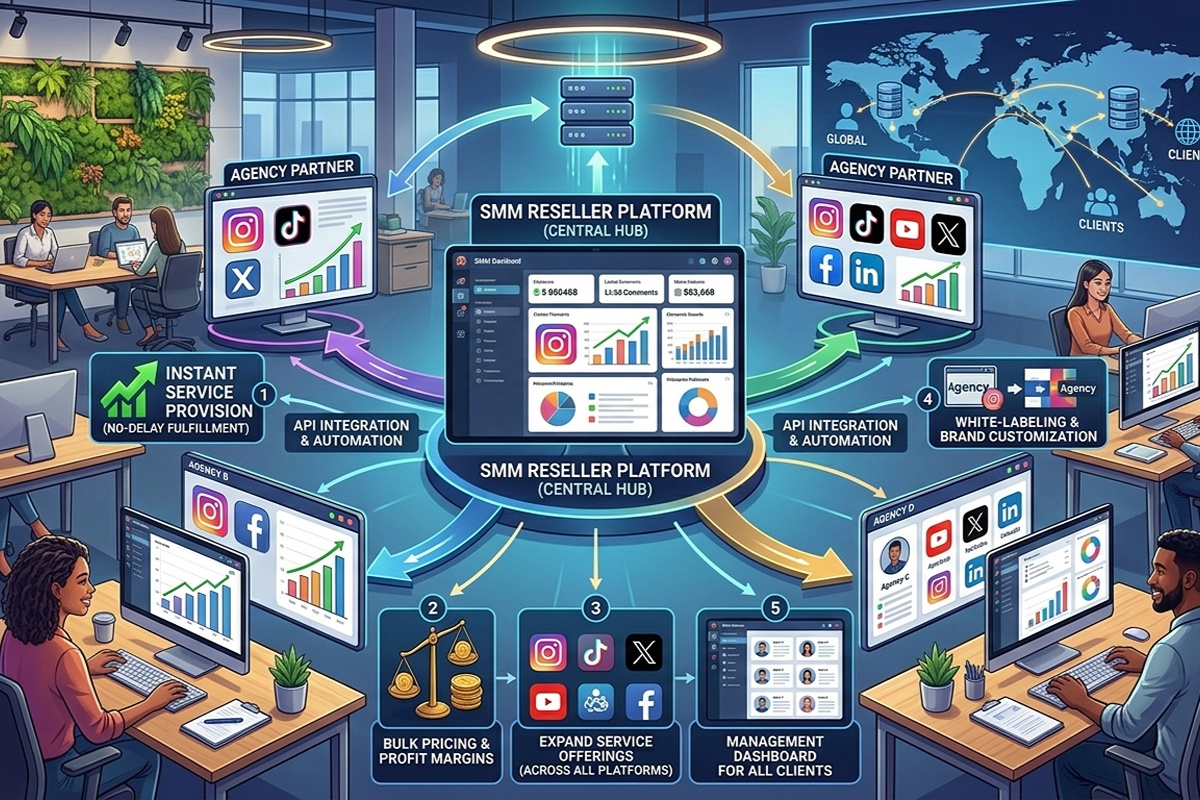
For agencies that manage multiple social media campaigns, having an organized and scalable workflow is essential. This is where SMM reseller platforms can become useful. By centralizing certain social media marketing operations, these platforms can help agencies manage services more efficiently while allowing their teams to focus on strategy and client needs.
Why Scalability Matters for Social Media Agencies
A small agency may initially manage only a handful of social media accounts. At that stage, many processes can be handled manually. As the client base grows, however, manual processes can become increasingly difficult to maintain.
Each client may have different goals, target audiences, platforms, and campaign schedules. One business may focus heavily on Instagram, while another may depend on Telegram, Facebook, TikTok, or other networks.
Without a structured system, agencies can spend too much time handling repetitive tasks and not enough time developing effective strategies.
Scalability therefore means more than taking on additional clients. It means increasing the agency’s capacity without allowing operational complexity to reduce service quality.
What Is an SMM Reseller Panel?
An SMM reseller panel is a platform that provides access to various social media marketing services through a centralized system. Agencies and resellers can use these platforms as part of their own service delivery processes.
Instead of managing every marketing-related task independently, an agency can use a centralized dashboard to organize specific services for different campaigns.
An SMM Reseller Panel can therefore become one component of an agency’s operational infrastructure.
The exact way a reseller panel is used depends on the agency’s business model. Some agencies may use such platforms to support client campaigns, while others may integrate services into a larger workflow involving content creation, social media management, analytics, and reporting.
The key is to treat the panel as a supporting tool rather than as a substitute for marketing expertise.
How Reseller Platforms Can Improve Agency Efficiency
One of the biggest challenges for agencies is repetitive operational work. When teams manage multiple clients, even relatively simple tasks can consume substantial amounts of time.
Centralized SMM platforms can help organize these activities in one place. This can make it easier for agencies to keep track of orders, services, and campaign-related activities.
Improved organization can have several benefits:
- Less time spent switching between different systems
- More consistent campaign workflows
- Easier management of multiple client requirements
- Better operational visibility
- More efficient allocation of team resources
These benefits become increasingly important as an agency grows.
Instead of building a completely different workflow for every client, agencies can establish standardized processes while still customizing the strategic approach for each brand.
Telegram as Part of an Agency’s Service Portfolio
Telegram has become an important platform for communities, publishers, creators, and businesses. Its channels and groups allow brands to communicate directly with audiences and distribute different types of content.
For agencies, Telegram can therefore represent an additional service area.
Agencies may help clients develop Telegram content strategies, promote channels, manage communities, and measure audience activity. Depending on campaign objectives, they may also use Telegram Marketing Services as part of a broader social media marketing workflow.
However, effective Telegram marketing requires more than increasing audience numbers. Agencies need to understand the client’s target audience and create content that provides a clear reason for people to join and remain active in the community.
This is why operational tools should be combined with content strategy and audience research.
Creating a Standardized Workflow for Multiple Clients
A scalable agency benefits from having clearly defined processes.
The first step is to establish the client’s objectives. Different businesses may prioritize brand awareness, traffic, engagement, lead generation, or community development.
Once the objective is clear, the agency can identify the appropriate platforms and content formats.
A basic workflow may include:
- Client onboarding and goal definition
- Audience and competitor research
- Platform selection
- Content planning
- Campaign execution
- Performance monitoring
- Reporting and optimization
SMM platforms can be integrated into the execution stage where relevant.
The advantage of this approach is that the agency does not need to reinvent its operational process for every new client. Instead, the framework remains consistent while the strategy and content are customized.
Why Agencies Should Avoid a One-Size-Fits-All Strategy
Standardization can improve efficiency, but it should not mean giving every client the same marketing strategy.
A restaurant, software company, personal brand, and e-commerce business may have completely different audiences and objectives.
For example, a creator might prioritize engagement and community development, while an online retailer may focus more heavily on website traffic and conversions.
The agency’s workflow can therefore be standardized, but its strategic decisions should remain flexible.
This distinction is particularly important when using SMM platforms. A centralized tool can simplify operations, but marketers still need to determine which services are appropriate for a particular campaign.
Combining SMM Tools With Content Marketing
Social media marketing does not exist independently from content.
Even a well-organized campaign needs useful and relevant material to attract attention. Content may include educational articles, videos, images, tutorials, customer stories, industry news, or interactive posts.
Agencies should therefore view SMM tools as part of a larger content distribution ecosystem.
For example, an agency working with a technology company might develop a series of educational posts, distribute short versions through Instagram, publish detailed resources on the client’s website, and use Telegram to maintain direct communication with an interested community.
In this model, technology supports the distribution and management process while the content remains the foundation of the campaign.
The Importance of Reporting and Data
Clients expect agencies to demonstrate the value of their work. This makes reporting an essential part of scalable social media management.
Reports should focus on metrics that relate to the original campaign objectives.
Depending on the project, agencies may monitor:
- Audience growth
- Reach and impressions
- Engagement
- Content views
- Website traffic
- Link clicks
- Leads
- Conversions
- Retention
Simply reporting large numbers can be misleading if those numbers do not contribute to the client’s objectives.
For example, an increase in followers may appear positive, but it becomes more meaningful when accompanied by stronger engagement or increased traffic.
Data should therefore be used to identify what is working and where adjustments are necessary.
The Role of Social Media Marketing Platforms
As agencies expand, they often need access to a wider range of tools. Managing every function separately can create unnecessary complexity.
A centralized platform can make certain parts of the workflow easier to coordinate. 7Panel, for example, can be incorporated into an agency’s broader infrastructure as a source of Social Media Marketing Services.
The value of such a platform depends largely on how it is integrated into the agency’s existing processes.
A marketing team can use technology to support operational efficiency while continuing to handle strategic planning, creative decisions, client relationships, and performance analysis internally.
This creates a useful division of responsibilities: platforms handle specific operational functions, while marketers remain responsible for the overall strategy.
How Agencies Can Scale Without Losing Quality
Rapid growth can create a difficult balance between quantity and quality. An agency that takes on many new clients without improving its processes may eventually struggle with deadlines, communication, and campaign consistency.
To avoid this, agencies can document their internal workflows.
Standard operating procedures can define how teams handle onboarding, campaign setup, approvals, publishing, monitoring, and reporting. Automation and centralized platforms can then be introduced where they provide genuine efficiency gains.
At the same time, agencies should regularly review their processes. A workflow that works for ten clients may need to be redesigned when the agency manages fifty.
Scalability is therefore an ongoing process rather than a one-time implementation.
Choosing the Right SMM Tools for an Agency
Before adopting an SMM platform, agencies should consider several factors.
First, the platform should provide services relevant to the agency’s clients and target platforms. Ease of use is also important because complex systems can create additional training requirements.
Agencies should also consider pricing structures, order management, service variety, reliability, and the ability to integrate the platform into their existing workflow.
Most importantly, the platform should support the agency’s business model rather than force the agency to completely change its processes.
Conclusion
SMM reseller platforms can play an important role in helping digital marketing agencies manage increasing workloads and serve more clients efficiently. By centralizing selected social media marketing operations, these platforms can reduce repetitive work and provide a more organized foundation for campaign execution.
However, technology alone does not create successful marketing campaigns. Effective social media growth still depends on audience research, quality content, strategic planning, creative execution, and continuous analysis.
For agencies, the most sustainable approach is to combine scalable tools with strong marketing expertise. When operational efficiency and strategic thinking work together, agencies can expand their client portfolios while maintaining a consistent level of service and adapting campaigns to the unique needs of every brand.